


9 Writing Mistakes That Undermine Your Credibility – And How To Fix Them
Your reader does not owe you their attention.
You must earn it. Yet pitfalls lurk when writing your thesis: how you handle sources, definitions, and data. And if you are not careful, you will annoy your reader.
This article covers nine writing mistakes that might undermine your credibility. Each one has a simple fix. Each one stems from forgetting that you write for a human being. Someone busy. Someone distracted. Someone who does not know your subject as well as you do.
1. Commenting on quotations to build credibility
A quotation alone proves nothing. You have read the author. You understand what they meant. But your reader does not know why you placed that quote here.
Instead of this: Smith (2019) states that "the cognitive load increases when tasks overlap."
Write this: Smith (2019) shows that cognitive load increases when tasks overlap. This finding matters for my own study because doctoral students juggle writing, data collection, and supervision simultaneously. The overlap Smith describes mirrors the daily reality of my participants.
The difference: You show the reader how you think. The quotation becomes a tool, not an ornament.
2. Writing a literature review that tells a story
A literature review tells a story. That story ends with one clear conclusion: here is why my work is necessary. When you simply stack quotations from different authors, you leave the reader to guess the plot.
Instead of this: Brown (2020) found X. Lee (2018) found Y. Garcia (2021) found Z. Therefore, more research is needed.
Write this: Early studies on doctoral writing focused on productivity (Brown, 2020). Later research shifted toward emotional factors such as anxiety and imposter syndrome (Lee, 2018). Garcia (2021) recently bridged these two perspectives by showing that productivity improves when emotional barriers decrease. However, no study to date has examined how daily writing routines interact with both cognitive and emotional factors. My research fills this gap.
The difference: You position yourself. You show what came before and where you stand now. The conclusion of your literature review becomes a springboard, not a placeholder.
3. Specifying data sources to earn reader trust
Data without a source is an opinion. Your reader needs to trace every number, every quote, every observation back to its origin. This applies whether you collected the data yourself or found it in a published report.
Instead of this: 65% of doctoral students report feeling overwhelmed.
Write this: According to the 2022 Doctoral Experience Survey (Thompson & Ali, 2023), 65% of doctoral students report feeling overwhelmed at least once per week (see Appendix A for the full questionnaire).
The difference: Transparency builds trust. Your reader can verify your claims. If you collected the data yourself, append the raw materials. Show your work.
4. Defining key terms before using them
You use certain words every day. Your reader may not share your definition. When you invent a new term or bend an existing one, you must explain what you mean. Quotation marks around a word do not count as a definition.
Instead of this: This study examines "resilience" among doctoral students.
Write this: This study defines resilience as the ability to return to a writing routine within 48 hours after receiving critical feedback. This definition narrows the broader psychological concept to focus specifically on academic writing behavior.
The difference: The reader knows exactly what you will measure or discuss. No guesswork remains. If you used quotation marks alone, the reader would wonder: different from what?
5. Placing definitions where readers can find them
Defining a term on its fifth appearance forces the reader to go back. They must reread every earlier passage with the new knowledge you just gave them. This wastes their time and damages their goodwill.
Instead of this: Paragraph 2: "The concept of conceptual blending appears frequently in student writing."
Paragraph 5: "Conceptual blending refers to the combination of two distinct ideas into a new framework."
Write this: Paragraph 2: "Conceptual blending refers to the combination of two distinct ideas into a new framework (Fauconnier & Turner, 2002). This concept appears frequently in student writing."
The difference: The reader moves forward only. They never need to flip back. You respect their time, and they notice that respect.
6. Replacing complex language with clear sentences
Complex subjects do not require complex sentences. In fact, the harder your subject, the more effort you must put into clarity. When you write a long sentence full of jargon and passive verbs, the reader suspects that you yourself do not fully understand the material.
Schopenhauer made this point well. He observed that obscurity and poor thinking often travel together. A writer who truly masters a subject can explain it simply. The writer who hides behind complicated language usually has little to say.
Instead of this: It was determined by the researcher that the implementation of a multiplicity of writing strategies could potentially facilitate the amelioration of productivity deficits among doctoral candidates.
Write this: Doctoral students who use multiple writing strategies improve their productivity.
The difference: The second sentence is shorter, clearer, and more confident. It takes a stand. The first sentence hides behind passive voice and inflated vocabulary. Your reader will thank you for every sentence you simplify.
7. Taking a clear stance on your research question
You have an opinion. You arrived at that opinion through months or years of reading, collecting data, and thinking. That opinion deserves to appear clearly in your thesis. Taking a stance does not mean being aggressive. It means being visible.
Instead of this: One could argue that feedback from supervisors affects student motivation. However, other factors may also play a role.
Write this: Supervisor feedback directly shapes student motivation. Based on my analysis of 42 interviews, positive feedback increases writing output by an average of 30% over the following week. Negative feedback has the opposite effect. While other factors such as peer support also matter, the supervisor relationship remains the strongest predictor of motivation.
The difference: The reader knows where you stand. You support your position with evidence. If someone disagrees, they must argue against your data, not against a vague hedge. Schopenhauer would approve: clarity and courage belong together.
8. Highlighting the originality in your thesis
You have original ideas. You have looked at your material and seen something that no one else has seen. But after months of working with those ideas, they feel ordinary to you. This is a trap. What feels obvious to you may be a gem to your reader.
Instead of this: This chapter presents the findings. Table 4 shows the responses. Section 4.3 discusses the implications.
Write this: This chapter reveals an unexpected pattern: students who write daily for short periods produce more original arguments than students who write in long weekly sessions. Table 4 shows this pattern across all four departments. Section 4.3 explains why short daily sessions may encourage risk-taking.
The difference: You name your discovery. You give it attention. The reader sees that you know what makes your work valuable. A good literature review helps you see your own originality. Use it.
9. Avoiding plagiarism while claiming your own work
Plagiarism means taking someone else's work without credit. This includes text, images, and ideas. But a less common problem also exists: attributing your own work to others. Some writers do this out of fear. They think, if X already said it, no one will attack me.
Both mistakes damage your credibility.
Instead of this (plagiarism): Writing anxiety affects completion rates. (No citation, but the idea came from Chen, 2020.)
Instead of this (reverse mistake): According to Chen (2020), writing anxiety affects completion rates. (But you discovered this pattern yourself in your own data.)
Write this: Chen (2020) first established that writing anxiety affects completion rates. My study confirms this finding and extends it by showing that structured writing groups reduce anxiety by 40% within eight weeks.
The difference: You give credit where credit is due. You also claim credit for your own contribution. The reader sees both the foundation and the new addition. Keep careful reading notes to avoid accidental plagiarism. Separate what you quote from what you think.
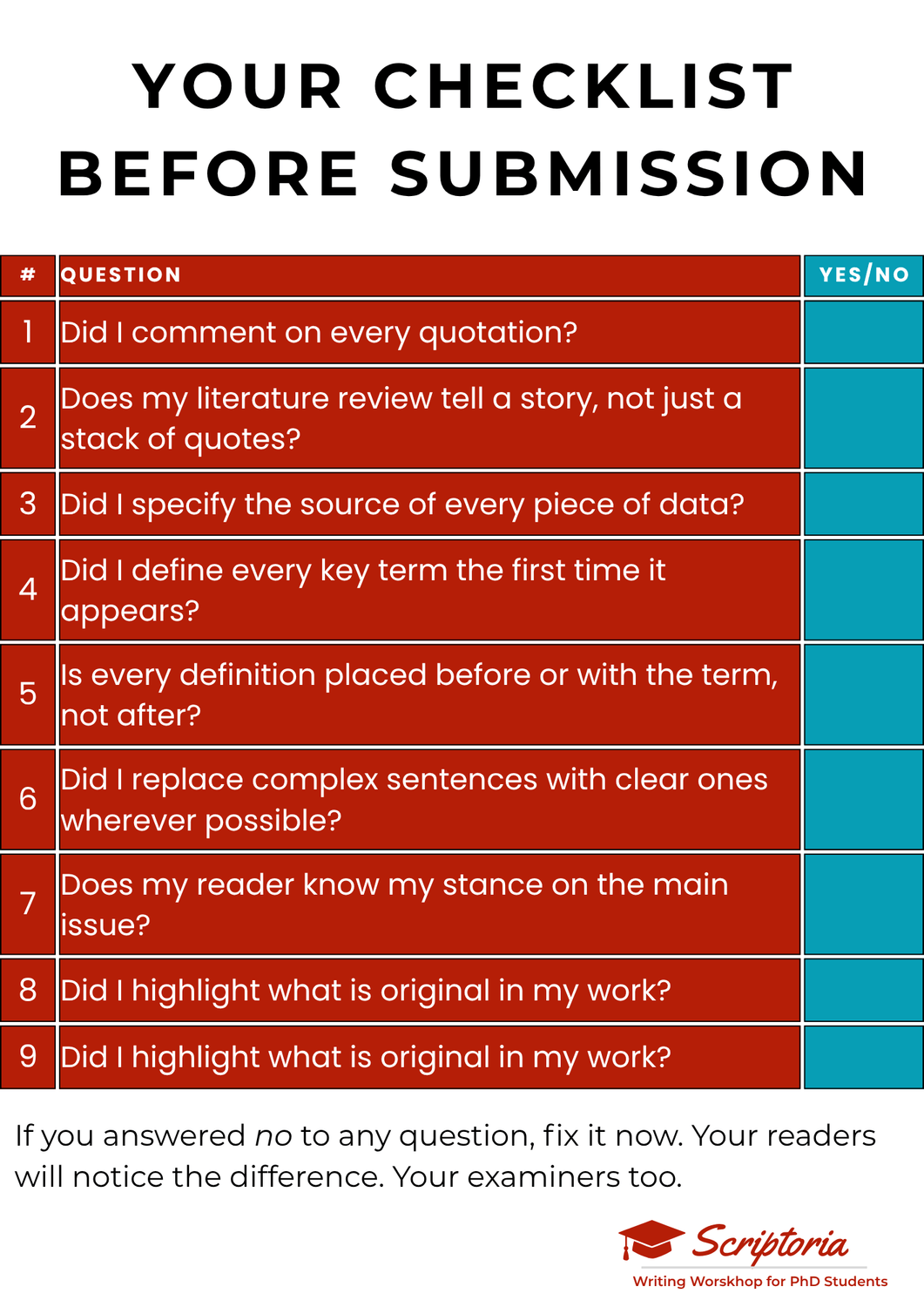
Checklist
Conclusion
Your readers are waiting. You earned their attention at the beginning of this article. Now you must keep earning it, page after page of your thesis.
The nine mistakes above all share the same cure: remember the human being who reads you. Define your terms before you use them. Comment on every quotation. Show where your data comes from. Take a stance. Claim your originality. Write clear sentences. Respect your reader's time.
Before you submit, reread your thesis. But not with your own eyes. Read it with the eyes of someone who does not know your field. Someone who has not spent three years inside your head. Someone who will meet your work for the first time.
Ask yourself: would I keep reading? Would I trust this author? Would I finish this chapter without frustration?
Complicating what is simple takes no skill at all. Any writer can hide behind long sentences, passive verbs, and undefined jargon. The real craft lies elsewhere. It lies in taking something complex and saying it in clear, simple language.
Your reader does not owe you their attention. But if you write well, they will give it to you anyway.
Which of these nine mistakes do you make most often? Or have you discovered a different mistake that belongs on this list?
Write your comment below. I read every response and will answer you.

Martha Boeglin
PhD in Philosophy. For over 23 years, I have supported doctoral students in writing their theses – more than 10,000 to date.
My approach: 100% action-focused. My training helps you structure your ideas and gives you a method to write faster, more clearly, and more smoothly.
Other Articles