


The PhD Diary: A Simple Writing Breakthrough That Elevates Your Research
Tired of blank pages? Drowning in ideas? The PhD Diary isn’t just a notebook—it’s your anti-chaos system for structured writing and mental clarity. Best part? You’ll finish work faster and reclaim guilt-free weekends —no overtime, just results.
How a PhD Diary saves your thesis (before It’s too late)
“I only understood my topic at the end of my Master’s thesis. By then, my text was a rushed draft—unfinished and inadequate. With my PhD, I refuse to repeat this mistake.”
– Richard, PhD Candidate
Richard’s story reveals a critical truth: Writing is not just for documenting research—it is how you clarify and advance it.
Yet most students wait until thesis deadlines loom, wasting months of potential progress.
Actually writing early is indispensable for a smart research.
Writing in your diary activates passive knowledge (what you think you know is not truly understood until you write it)
Writing in your diary prevents last-minute chaos (no more 11th-hour rewriting the same paragraph).
Writing in your diary builds confidence (you can track your intellectual growth over time).
Don't wait until you "know enough" to start writing. That moment never comes. Writing is not the final step of research—it is how research begins to take shape.
When you read scientific literature, you are already thinking, doubting, comparing, and interpreting. All of these are acts of writing in their raw form. If you postpone writing, you postpone clarity.
That's why, to avoid those 7 traps when you read scientific literature, you need more than good intentions—you need a practice. And that practice starts with your PhD notebook. Start it on day one. Write while you read.
7 reasons to use a PhD Diary: from understanding to saving your thesis
Understand and explore your topic
Writing in your PhD diary helps to examine a topic from different angles: brainstorm your topic, draw mind maps to consider all aspects of an issue. Writing regularly reveals what you truly understand and what remains unclear.
Structure your thoughts
Instead of keeping your ideas jumbled in your mind, the diary offers a space to organise them. Clearly separate the steps: gathering ideas, sorting them, and then organising. You will see how the structure gradually emerges before your eyes.

Identify gaps in your knowledge
By linking information through writing, you can more easily spot what you don’t know. The diary transforms the vague feeling of “I don’t know anything” into a precise map of areas that need further exploration.
Connect knowledge
Daily writing creates bridges between readings and experiences. Unexpected connections become visible. What once seemed scattered gradually forms a coherent whole.
Gain critical perspective
The diary develops critical thinking by allowing you to question texts, positions, statements. You gradually find your own academic voice. Regular writing sharpens your ability to analyse and argue.
Achieve intellectual clarity
The more you write, the clearer your ideas become. The diary is a space to clarify your thinking before formalizing it. Repetitions and reformulations lead to more precise expression.
Keep your goals in focus
The PhD diary transforms vague intentions into written commitments.
By regularly capturing what matters, you stop drifting and start progressing. Combine it with SMART goals and you'll never lose sight of why you're reading a paper or writing a text.
Save your thesis
In times of doubt, rereading your diary shows how much progress you’ve made. It can prevent writer’s block by already structuring the essentials. It is a living proof of your intellectual development. It will even re-energise you when you feel like giving up.
What can you write in your diary?
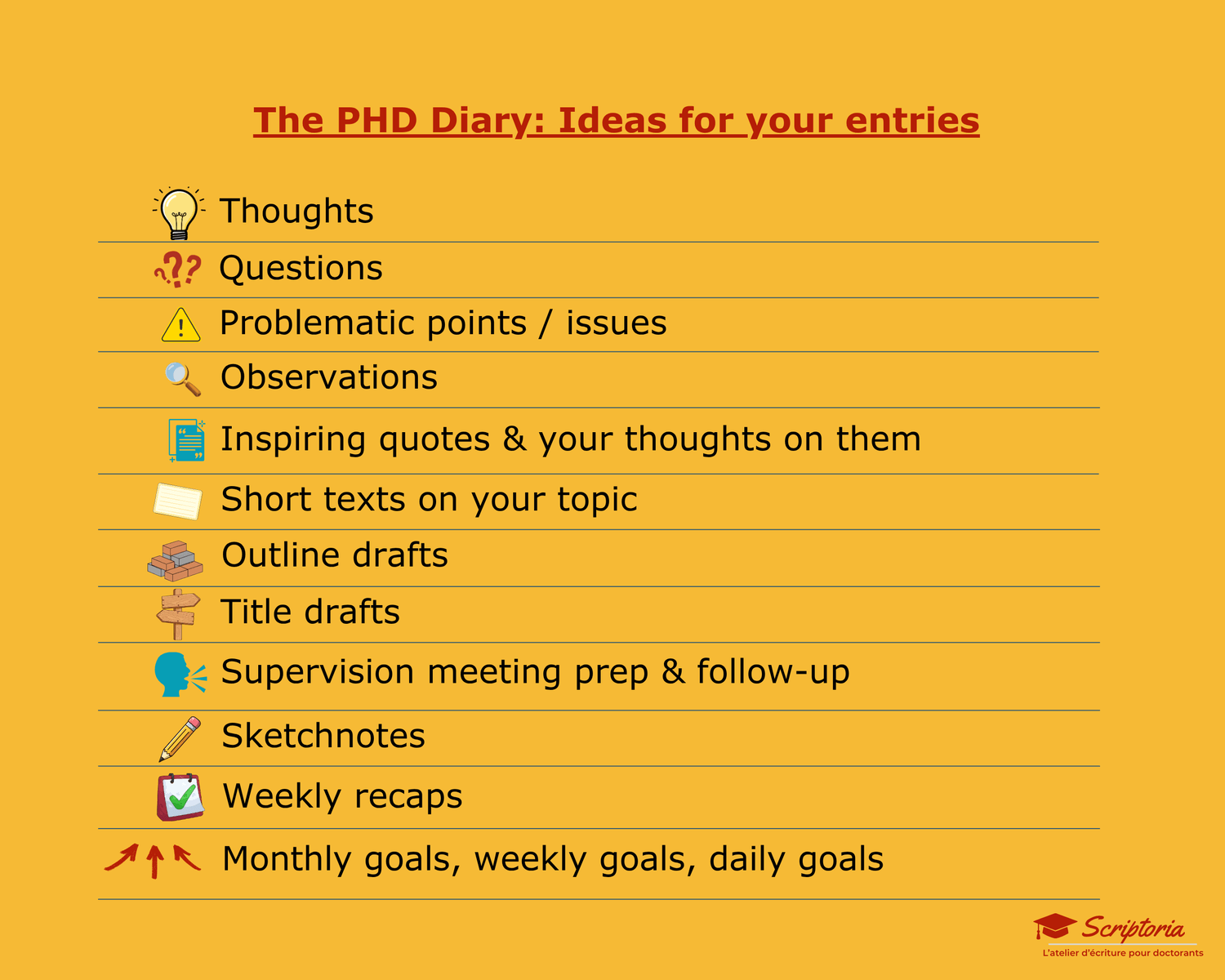
Questions and problems
Simply writing down questions or problems often leads to solutions. Even when answers don’t come immediately, the act of recording them helps your brain work toward finding them.
Thoughts and observations
Note anything that seems interesting or important—these recorded observations become seeds for developing new ideas later.
Brainstorms and mind-maps
Early ideas rarely arrive perfectly formed. Brainstorming and mind-mapping help visualize concepts, gather scattered thoughts, and spark fresh connections.
Topic-related texts
Capture reflections on specific questions, issues, or quotations relevant to your research. These fragments often grow into key sections of your work.
Outlines
A strong outline serves as the skeleton of your text. While crafting one takes time and effort, this foundation makes thesis writing significantly easier than working with a disorganized structure. Explore all possible options when outlining.
Feelings
Document both positive and negative emotions. Writing about conflicts can provide clarity and calm, while recording achievements creates a reservoir of motivation for challenging days.
A tip: use colours, symbols and pictures. They will help you to find what you are looking for more quickly. The brain retains colours and pictures better than words.
Weekly summaries
Answer these guiding questions to track progress:
What have I accomplished this week?
What key discoveries have I made?
What should I prioritize next week?
Goal setting
Establish clear targets at different timeframes: Monthly goals (for overarching milestones), weekly goals (for medium-term progress), daily goals (for focused productivity).
📌Always record the date. This will show you the evolution of your thoughts over time. Your diary witnesses your intellectual and scientific development – to see this growth is rewarding.
Your PhD diary: your research companion
Unlike a formal lab notebook meant for others to read, your PhD diary is a private space for your eyes only—free from supervision or judgment.
This personal notebook serves as your thinking playground:
Write freely without self-editing or worrying about grammar
Explore ideas through messy drafts and rambling thoughts
Use an A4/A5 format to encourage deeper reflection (small notebooks limit thinking)
Remember: Those long, imperfect passages often lead to your most valuable insights. The process of writing without constraints helps uncover ideas that polished prose might never reveal. More tips in Unlocking your thesis writing super powers.
Why a paper notebook outperforms digital tools for PhD research
Spontaneous insights are quickly captured
The most innovative ideas often emerge away from your desk—during walks, conversations, or moments of relaxation. A paper notebook’s portability lets you immediately preserve these fleeting thoughts that might otherwise vanish.
Messy thinking is often the key to clear thoughts
Unlike digital documents that subconsciously demand perfection, handwritten pages welcome unfinished ideas. This freedom to brainstorm without self-editing is where breakthrough connections often form.
A visual relief
After hours staring at screens, a notebook offers visual relief while maintaining productivity. The physical act of writing by hand engages different neural pathways, often yielding fresh perspectives.
Hardwired creativity boost
Your brain literally thinks differently with pen in hand. For computer-weary researchers, handwriting unlocks fresh neural pathways to solutions.
Unlock hidden gems in your research diary
Mine your golden nuggets
Don’t let brilliant ideas gather dust. Schedule monthly review sessions to:
rediscover forgotten insights
spot patterns in your thinking
rescue valuable concepts from oblivion
Proactive review system
Take time to review your diary regluarly.
rediscover forgotten insights
spot patterns in your thinking
rescue valuable concepts from oblivion
How to review your PhD dairy:
star immediately useful ideas
flag potential future directions
transfer actionable items to your research plan
The compound effect
A daily practice of just 5-10 minutes of writing, combined with regular reviews, creates powerful results over time.
This simple habit will systematically clarify your research concepts, dramatically simplify thesis structuring, and gradually transform chaotic notes into publication-ready material.
The small, consistent effort compounds into significant academic progress.
Your next steps
For new researchers: begin with an A4 or A5 notebook today. If you are a current diary user, schedule your next review session now.
Have you started your research diary yet? Share your experience in the comments: your tips could help fellow PhD students take their first step!

Martha Boeglin
PhD in Philosophy. For over 23 years, I have supported doctoral students in writing their theses – more than 10,000 to date.
My approach: 100% action-focused. My training helps you structure your ideas and gives you a method to write faster, more clearly, and more smoothly.
Other Articles