


From Overwhelm to Order: PhD Goal Setting That Works
Every project starts with a vision, but turning it into an achievable goal is key—especially for doctoral research. A PhD diary helps break down complex ideas, track progress, and stay motivated. In this article, we’ll show you how to set clear, actionable goals for your research.
A goal is a dream with a deadline.
Napoleon Hill
Why do you need to set goals?
1. Goals give you a clear direction
Doctoral research is like an expedition into an unknown country. You need to know your destination in order to create a road map. You need to have a clear endpoint that you want to reach. Otherwise, you might start researching areas that seem exciting but are off-topic.
2. Goals help you to make decisions
When you know what you want to achieve, it is easier to identify which paths represent unnecessary detours. It is easier to leave aside what is not going to help you to reach your goal. This is in complete contrast with when you do things based on a whim, just because something sounds interesting, exciting – but is actually off-topic.
3. Goals help you to measure your progress
As a goal is an endpoint, you can measure how far you have already come. I’d like to mention the case of Christina, a former participant of my writing workshop. She had been trying to write her thesis for more than 2 years, with a job and a family – some days she would write for 18 hours, and then nothing for weeks. This stop and start rhythm was continuously breaking her train of thoughts and was exhausting. After the workshop, she set a clear goal: my thesis will be written by 31 July. In order to reach her goal, she set a clear interim goal: every working day, 90 minutes of writing. Some days she wrote one page, other days five. Her thesis was written within 6 months, without stress nor panic.
4. Goals help to curb procrastination
If you have a clear idea of what you what you want to achieve, and what you have to do, it is easier to take action than if you firstly have to decide what it is that you want to do today.
5. Goals boost motivation
The clear picture of what you want to realise provides you with the foundation for your action. By giving yourself a concrete endpoint to reach, you enhance your motivation. You know what you want to focus on, so you put all your efforts into it. You have probably had this experience: you must send your paper by a given deadline – you have 24 hours. The goal is clear, the time available also. Suddenly, you are not procrastinating any more – you focus on the essentials, you put 100% of your energy into your paper and get the task done (and get excited about it).
6. Goals help to reduce the quantity of work
If you have no clear goal, you will never feel like you have finished your work. You need to read more, to write more, to do more. But if you have a clear goal, you know when you have reached it. When your goal is reached, then you don’t need to read more, to write more, to do more. The work is done – you can congratulate yourself and relax!
Learn to set achievable goals
There is a formula to define achievable goals: the SMART goal formula.
SMART is an acronyme for Specific, Measurable, Achievable, Realistic, Time-bound.
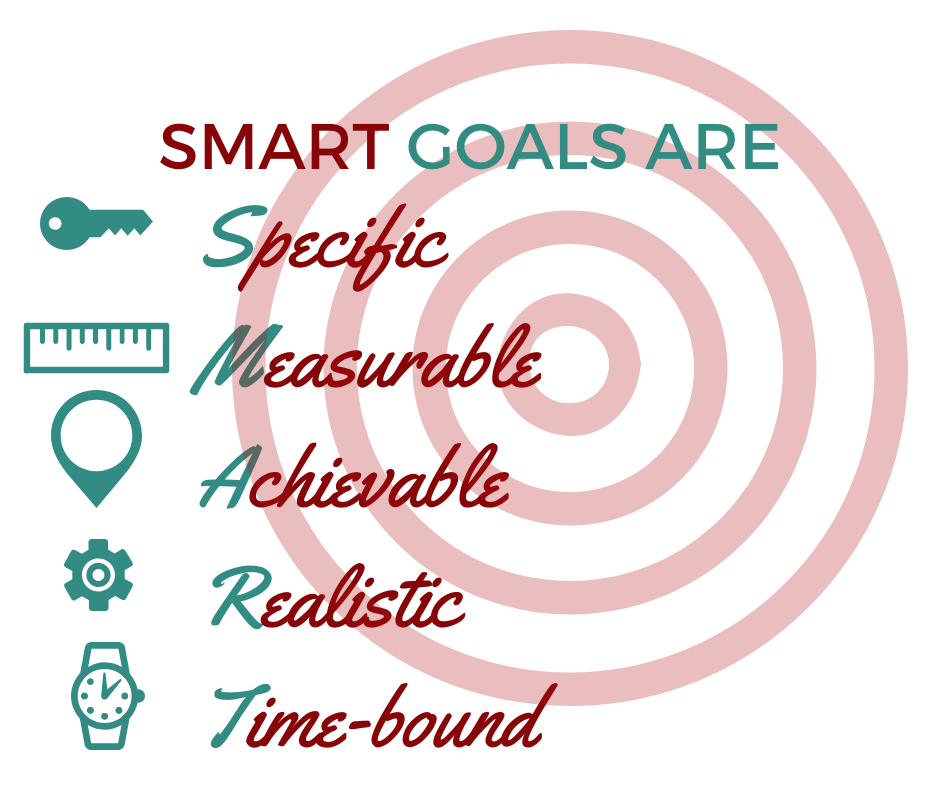
What does it all mean?
Let’s look at each term with more details.
Specific. The more specific you define your goal, the easier it is to reach it. Avoid vague goals: you might lose time and get lost in the details. Your goal needs to be as concrete, as specific as possible. What does it look like? Close your eyes and imagine yourself having reached your goal. How will you feel when you reach it?
Measurable. What is measurable is manageable. Setting a measurable goal shows you whether it is realistic. If you say : I want to write my thesis at the week end, you will probably end up doing anything but writing. If you say: I will write 10 pages, or I will write for 2 hours, the task becomes concrete. Then you can consider if 10 pages or 2 hours are realistic or not – and adapt the goal if necessary. What concrete criteria will you use to measure your progress towards the achievement of your goal?
Attractive. If your goal is unattractive, you will not be motivated to work on reaching it. If your goal feels unattractive, find a way to make it attractive: what will it take to reach it ? What will change in your life once you have reached it ?
Realistic: Your goal must be realistic – if it is not, you will not reach it. Many PhD students set too ambitious goals. Too ambitious goals that they cannot reach. Because of the time, because of the resources that are available. Is your goal realistic?
Timely. Set deadlines for achieving your goal. A time frame forces you to focus your work towards the achievement of your goal. When do you want to have achieved your goal?
Phrases to Avoid When Setting Goals
Wording is crucial.
A goal properly set is halfway reached.
Zig Ziglar
Beware of overly vague formulations.
Let’s look at four common mistakes I often see in my workshops for doctoral students:
1. “I want to prepare my presentation.”
“Prepare” can mean anything and nothing. What does “prepare” entail here? Jotting down rough ideas? Making an outline? Selecting visuals? Rehearsing in front of a mirror? If “prepare” means having it finished, then say so directly. A SMART goal would be: “By Friday at 1 PM, my presentation will be ready.”
2. “I want to work on Chapter 2.”
Again, how will you know you’ve achieved this? What does “work on” mean? Writing two lines? Completing the chapter? The spectrum is vast. A SMART goal could be: “Finish Chapter 2 by Friday at midnight” or “Complete the chapter outline by Tuesday.” Better a goal achieved early (allowing you to set the next one) than an unrealistic goal due to poor wording.
3. “I want to start writing.”
What criteria will confirm you’ve met this goal? Writing one sentence is a start; drafting an outline is too. Always ask: What tangible evidence will show I’ve succeeded? If needed, rephrase to include the M (Measurable) of SMART.
4. “I want to understand how X works.”
Like “know,” “understand” is nebulous. The more you learn, the more you realize how much you don’t know—turning this goal into a bottomless pit. Replace it with specifics: “Identify the 3 key mechanisms behind X’s function,” “Locate the components that activate X,” or “Determine the 5 critical factors for X’s operation.”
Clear Goals Simplify Your Life
Adopt these practices:
Never read academic texts without defining your purpose first.
Never start drafting without clarifying the goal of the text.
Each evening, plan the next day’s primary goal and three key steps to achieve it. Write this down.
Result? You’ll sit at your desk already knowing what to do—saving time, energy, and mental clutter.
Celebrate Every Step Toward Your Goal!
Setting SMART goals turns your thesis work into a series of clear, achievable steps. Instead of feeling overwhelmed, you gain control—each small victory bringing you closer to completing your research.
In long-term projects like a thesis, we tend to fixate on the remaining work rather than progress made. This breeds frustration, self-doubt, and exhaustion—all counterproductive.
SMART goals let you track progress. Every milestone, however small, is forward motion.
For that reason, celebrate every step toward your goal: when you achieve a sub-goal, pause and acknowledge it. Close your eyes and give yourself genuine praise.
Savour these moments—they’ll boost motivation and self-confidence.



Martha Boeglin
PhD in Philosophy. For over 23 years, I have supported doctoral students in writing their theses – more than 10,000 to date.
My approach: 100% action-focused. My training helps you structure your ideas and gives you a method to write faster, more clearly, and more smoothly.
Other Articles