


PhD Writing Routine: How to Start Your Day Actively
You need hours — painfully slow hours — just to get into your writing. You sit down at your desk, but your mind wanders. You open your document, then somehow end up checking emails or clicking links. Sound familiar?
The problem may not be you. It may be how you start your day.
In this article, I’m sharing a small change I made to my work routine. A change that helped me get into writing quickly, saved me hours of work, and improved my concentration.
The solution is simple: start with what fosters concentration, not what distracts you. But there’s a catch: this only works if you prepare the night before. Keep reading, and I’ll show you exactly how.
How do you start your working day? (My bad habit with emails)
For a long time, my own working day began with reading my emails. And when you start reading your messages, there are always some to reply to.
I couldn’t imagine starting the day any other way: there were always questions from students to answer, organisational matters to sort out. Since not everyone communicates by email, I would check my messages on WhatsApp and Signal. Then social media: LinkedIn. Then Instagram.
And then I’d grant myself a break (I was already tired before I’d even properly begun my day): I’d read the news online.
By midday, I had the unpleasant impression of having done nothing yet. I wouldn’t start working until the middle of the afternoon. And I was slow. Very slow.
Annoyed at having wasted so much time in the morning.
Tired from having spent so much time with my eyes on the screen.
Anxious at realising that, once again, I was going to finish much later than planned.
Feeling guilty because, once again, I was going to skip my exercise session due to unfinished work.
It was when reading Content Terminator by Walter Epp — particularly his chapter on the three Cs — that I changed how I organised myself, with a tremendous effect on my productivity.
I changed the order of the three Cs: Connection, Consumption and Creativity.
Begin your day with the right C: why creativity comes first
If you start your day with Connection, then what follows is minutes or even hours of Consumption: you consume content, some of it undoubtedly high quality. But you are in a passive frame of mind. Your brain receives a myriad of inputs.
The stimuli it receives are, moreover, of a varied nature. And, consequently, the sources of distraction are numerous.
You are swallowed up by the world.
You step outside yourself.
How, afterwards, can you come back into yourself?
How, afterwards, can you concentrate on your work?
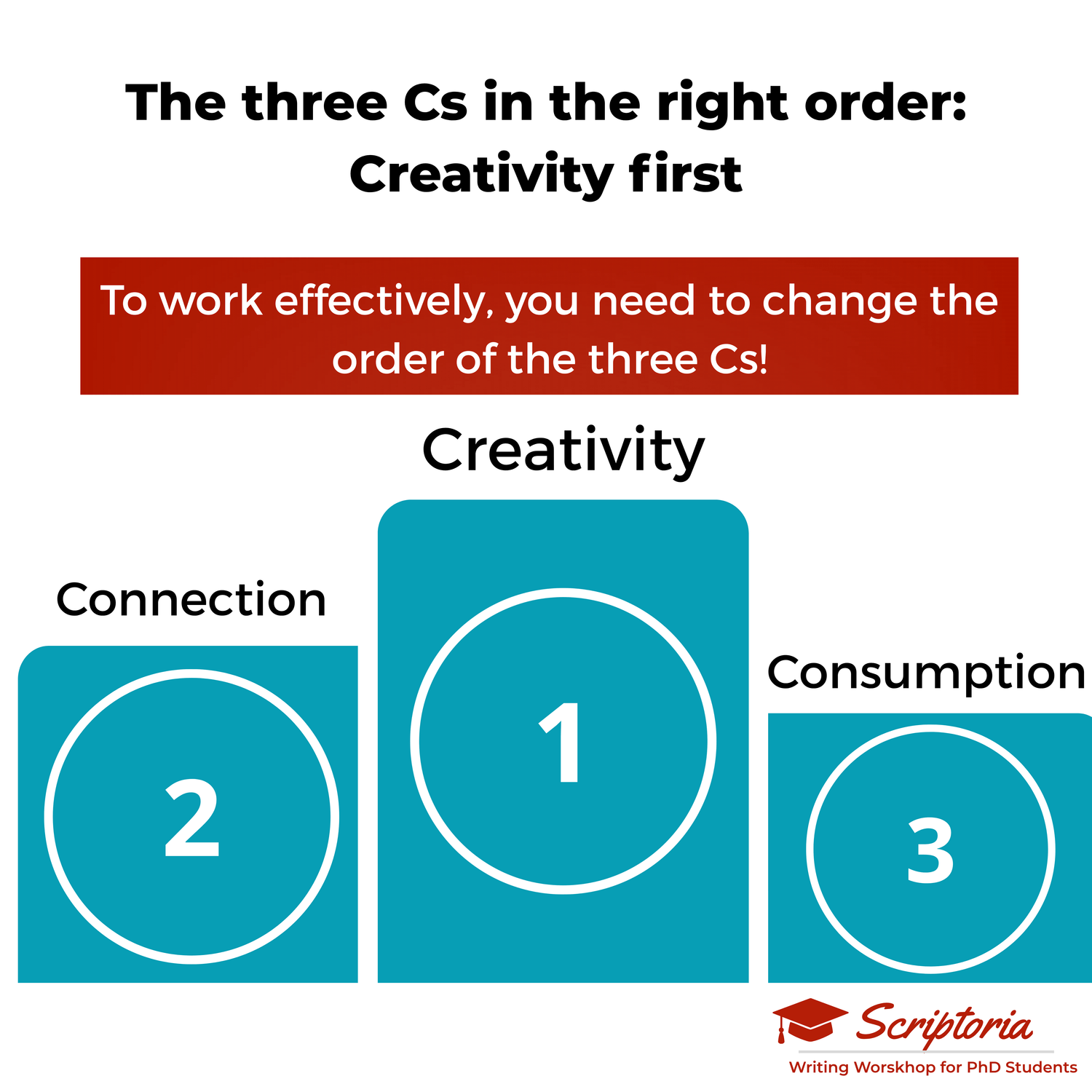
Start the day by focusing on what you want to do: give priority to Creativity.
Write first. It’s up to you to decide how much time you want to devote to writing: ten minutes or three hours. But in any case, start your day with what is your priority: writing your thesis.
Once you’ve fulfilled your daily quota, then you can go online. Then you can read your emails, surf the web or check social media.
And then you will consume.
Start with what takes priority
Start with what is a priority. Please remember : priority comes from the Latin prior, which means first.
If you are in a thesis-writing period, then writing is your priority: it comes first in the order of the three Cs.
Caution: what comes first is unique. Having several priorities means having none at all. If you tell yourself: “I’m going to read and to write and to prepare my next course at same time, they’re all priorities” , I’ll let you guess which one will take first place… and which one will fall by the wayside.
If you want to give priority to your thesis, then start your day with it. And you’ll see that, even if you then move on to something else, that first moment of the day will have an impact on your thinking.
Your brain will continue to mull things over in the background.
Help yourself: start the day with what is a priority. You’ll see that, even if you only devote a little time to the C of Creativity, you’ll begin your day in an active way. In doing so, you’ll feel you’ve accomplished something concrete that day.
3 advantages of starting your day without the internet when you write your thesis
Greater autonomy
You will see that starting your day without checking your messages on the various communication channels does not harm communication. On the contrary.
By not responding early in the morning, you’ll see that some questions will find answers over the course of the day without you having to intervene. You aren’t indispensable. People become autonomous when you’re not immediately available.
Knowing they are autonomous, you’ll stop feeling guilty about not replying to them straight away. And you’ll feel more autonomous. It’s a win-win!
Better concentration
When you’ll sart the day with Creativity, you’ll feel you’re making progress in your work more quickly. Because your mind isn’t yet occupied by the interactions and exchanges you’ll have during the day: you’re concentrated from the outset.
Better: after an hour you’ve already produced something. You haven’t necessarily finished it, but at least you’ve put something in place on which to build the rest.
A stimulus for the brain
Carolina, a PhD student, told me, once she began the day with Creativity:
“Often, I only have half an hour in front of me when I start the day with the Creativity. But that half hour is decisive: it’s as if my brain, primed by that first half hour of creative work, continues to work without me being aware of it. It mulls things over, processes them, structures them.
And when I have more time — at the end of the day — to take up the work I began that morning, I find it much easier to get back into it.
Even when I’m not consciously working on my text, just starting my day gets my brain going. Throughout the day, ideas spring to mind about my topic — often when I’m doing something completely unrelated.”
How to increase your chances of starting well: the power of conditioning
Preparing the day before actually conditions your brain. When you repeat the same small actions every evening — noting what to write, how long it will take, and where your materials are — your brain begins to recognise a pattern.
Over time, this pattern becomes automatic. You no longer need to fight yourself in the morning. You don’t waste willpower deciding what to do or where to start. Your brain simply follows the routine. It has been trained to expect writing, not wandering.
Prepare the night before
The better you prepare the night before, the easier starting becomes. is is the hidden power of conditioning: what once took you hours of procrastination and hesitation can turn into a smooth, even effortless launch into your work.
How to proceed?
Set up a routine before leaving your desk:
Write down what you want to write the next day.
Note how much time you will spend on it.
Prepare the materials you will need.
Why does this work? Because when you know what you're going to do, and you've prepared the materials you need, then arriving at your desk the next morning becomes simple: all you have to do is sit down and start. It's much easier than when you first have to decide what to do and search for your materials.
When you prepare the night before, you initiate a flow that is easier to continue the next day. You're not starting from zero: you're continuing what you already set in motion.
There is another layer to this routine, and it’s even more powerful than you might think: visualisation.
Before falling asleep, take one minute to visualise how you will start your day. See yourself sitting at your desk. See your notes, your materials, already prepared. See yourself opening your document and beginning to write. Without hesitation, without checking emails, without distraction.
This simple mental rehearsal is not daydreaming. It’s a tool that many high performers use to prime their brain for action. When you visualise a task, your brain activates the same neural circuits as when you actually perform it.
So by the time you wake up, your brain has already rehearsed the start of your work session. The resistance is gone. You just have to sit down — and your brain knows exactly what to do.
This is especially useful for PhD students who often need long hours just to get into their work.
The real game changer? Starting your day with the right C
To write your thesis, you need structure and maximum concentration. It doesn’t matter if your best hours aren’t in the morning. Starting with Creativity — even if the quality isn’t perfect — helps you begin in a focused way.
What you must avoid at all costs is starting with the internet. Once you connect, the machine is set in motion. Ten minutes online always turn into urgent emails, irresistible links, and impulsive research ideas.
Do yourself a favour: start your day with the right C.
Try it tomorrow morning. Before you go to bed tonight, write down one thing you want to write tomorrow. Just one.
Then, when you wake up, start with that — not with your phone.
Let me know in the comments: will you try starting with Creativity tomorrow?
Martha Boeglin
PhD in Philosophy. For over 23 years, I have supported doctoral students in writing their theses – more than 10,000 to date.
My approach: 100% action-focused. My training helps you structure your ideas and gives you a method to write faster, more clearly, and more smoothly.
Other Articles