


Writer's block during your PhD
2:23. Cold coffee. Blinking cursor. Empty screen.
You have it all in your head. The ideas, the findings, the conclusions. But when you try to write the first line… Nothing. Silence.
Stop punishing yourself. Writer's block is neither a lack of competence nor intellectual laziness. It's a mixture of fears, pressure, and wrong methods.
Here are the 7 most common causes of writer's block among PhD students – and for each cause, a concrete action you can take right now.
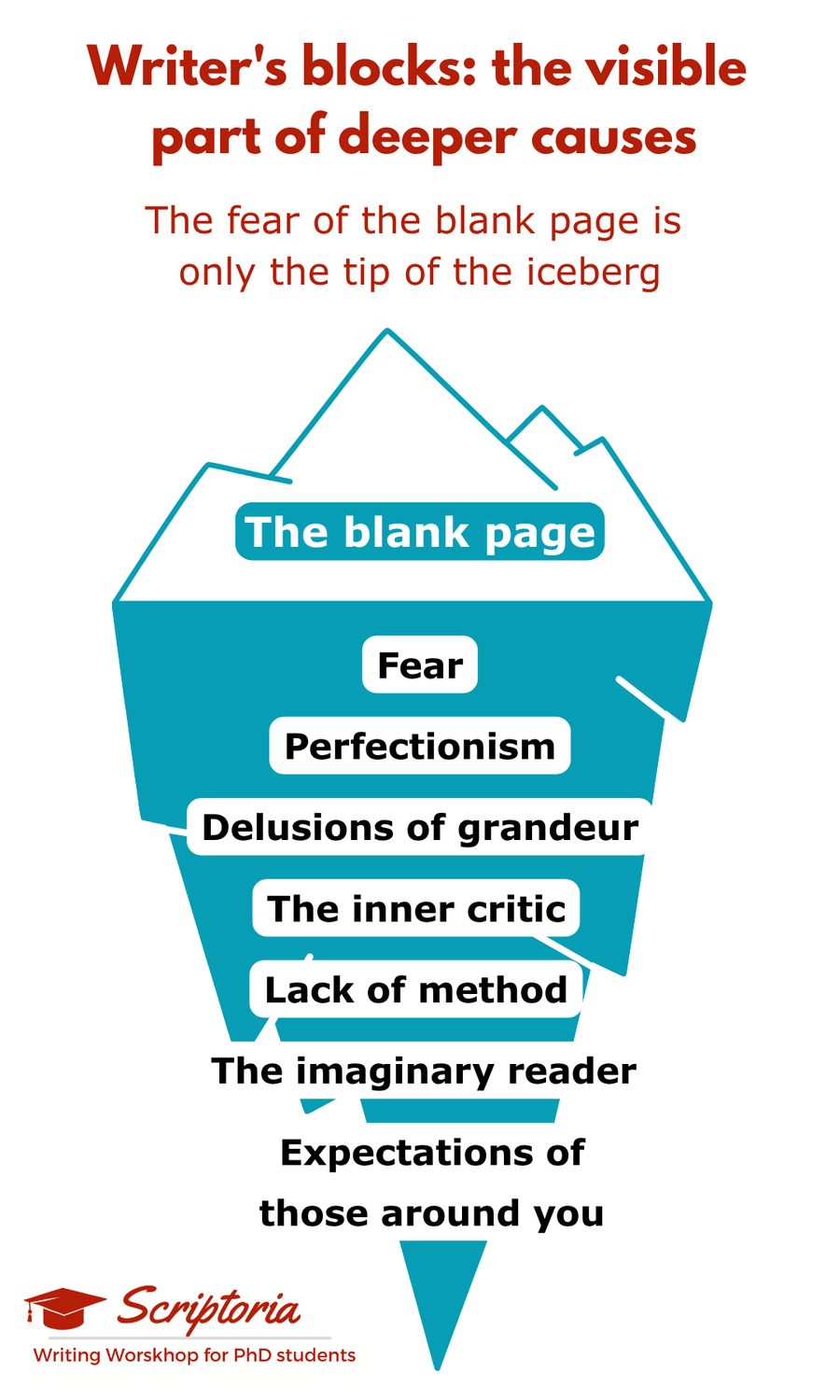
1. Fear: an inner disaster machine
Fear blocks you. It prevents clear thinking. It makes you imagine monsters lurking in the dark, ready to devour you.
When writing a PhD thesis, the causes of fear are many:
Fear of your supervisor
Fear of the examination committee
Fear of not knowing enough
Fear of your own originality
Fear of comparing yourself to others
Fear of your own inadequacy (the so-called impostor syndrome)
Fear of success
Fear of disappointing someone
Fear of your own high standards
Fear of the end
Quick fix (2 minutes)
Ask yourself: what exactly am I afraid of?
Name it. Write it down.
Diffuse fear paralyses you – known fear you can fight.
2. Perfectionism: the enemy of progress
You find the sentence not good enough to express your thought. Youl keep polishing. Again. And again.
What it does to you: you spend two hours on one paragraph. You don't move forward. In the end, you can't even look at your own text anymore.
I once met a PhD student who revised her manuscript from 250 to 3,000 pages. Her supervisor demanded a maximum of 300 pages. She never submitted her thesis.
Quick fix (2 minutes)
Decide what you will write about. Set a timer for 25 minutes. Write without correcting. No deleting. No rewriting. At the end, you have a text. Imperfect. But existing. You can improve it later.
Remember: better a finished thesis than a perfect thesis that doesn't exist.
3. Delusion of grandeur: a common trigger of writer's block
You might find yourself thinking:
"My thesis will revolutionise my field."
"I have to find the one perfect solution to my research problem."
"Everyone will read my thesis and admire me for it."
What it does to you: the bar is set so high that you don't even dare to start. Why write if it isn't great straight away?
The trap: ambition isn't the problem. It's ambition without a rough draft. Even Nobel laureates started with messy notes.
Quick fix (3 minutes)
Write down the sentence that keeps occupying your mind – for example: "My thesis will revolutionise my field."
Then replace it with, for example: "Today I want to write a single page about a single finding."
You can always improve later. But first, the text needs to exist.
4. The inner critic: a nasty little voice
Does this sound familiar?
"You're a fraud”
"Your office mate is so much better than you."
"You don’t belong here."
What it does to you: it doesn't say "You could improve this passage". It says "You're not good enough". The result: you stop writing. You keep researching, trying to finally become "good" (even though you already know enough to write your thesis).
Where does it come from? Old experiences, remarks, comparisons. But your inner critic doesn't have a PhD, does it? So why give it a voice?
Quick fix (4 minutes)
Write down a typical sentence from your inner critic. For example: "You'll never finish this anyway."
Answer it in writing as if you were a kind colleague: "Thanks for your input, but right now I need a first draft, not a masterpiece."
Then add: "This is just a rough version. I'll revise it later."
5. Lack of method and the big chaos in your head
Everything seems connected to everything else … You don't know where to start.
What it does to you: you're standing at the foot of Mount Everest without a map. You start at one corner, lose your way, give up.
The truth: the problem isn't you. It's the lack of structure. You don't build a house by starting with the roof.
Quick fix (10 minutes)
Formulate the SMART goal of your chapter in one sentence: "This chapter aims to show the impact of X on Y in the case of Z."
List 5 big ideas, without putting attention on the order.
List them in the correct order.
Add a maximum of 3 sub-points per idea.
This simple plan is your navigation system. You can refine it later.
Tip: a mind map on paper solves writer's block for 90% of the participants in my courses – in less than 10 minutes.
6. The imaginary reader: your supervisor inside your head
Your inner voice whispers:
"Not rigorous enough … not analytical enough …"
"My supervisor will tear me apart if I write this…"
“If I say this, my supervisor will realise that I am a fraud…”
Warning sign: you spend more time anticipating criticism than writing (this is a typical writer's block for PhD students).
What it does to you: you no longer write to move your thinking forward. You write to avoid criticism. Every sentence becomes a plea.
I've experienced this myself: while writing my own PhD thesis, I could hear my supervisor internally criticising me before I had even written anything. The result: a very long writer's block.
Quick fix (1 minute)
Change your audience. Don't write for your supervisor or the examination committee.
First, write for yourself. Tell yourself: "This first draft is for me. I'm writing to understand. I'll improve it for others later."
Or write for a kind person in your life. Explain what you're doing. Write down their questions. Answer them.
7. The expectations of those around you (or when your PhD becomes a family matter)
You catch yourself thinking:
"My father invested so much … I can't disappoint him."
"If I fail, my husband/my wife/my parents/other people won't love me anymore."
What they do to you: you see monsters everywhere. You no longer write – you imagine your own public execution.
The thesis is no longer a piece of academic work. It becomes a proof of love, a social bet, a test of your personal worth. The pressure becomes unbearable.
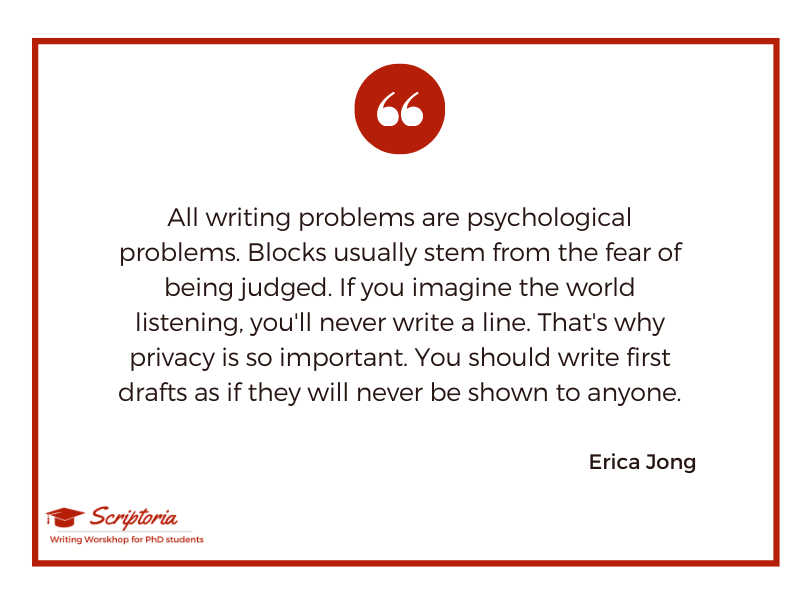
The key insight: you are not your thesis. Your thesis will be judged. You yourself will not.
Quick fix (2 minutes)
Say the following out loud three times: "My PhD thesis is an academic object. It does not determine my worth. I can partially fail and still carry on."
Then ask yourself: "What is the actual most likely bad outcome?" Certainly not the catastrophe you're imagining.
Writer's block: no reason to panic
Writer's block has nothing to do with a lack of talent or ability. It's more a symptom that you're demanding too much, too soon, in the wrong place.
The secret: writing means, first of all, just being there. Badly. Provisionally. Imperfectly. Improve later. Not before.
In other words: writer's block is normal. It's part of the writing process, like headwind is part of cycling. Everyone who has written a long academic text knows it.
The problem isn't the block itself. The problem is that you don't recognise its causes – and remain paralysed for a long time.
The good news is: a block is not a permanent state. As soon as you can name the cause – fear, perfectionism, delusion of grandeur – you have taken the first step. Then you can act.
Not tomorrow. Not next week. Now.
P.S.: More tips in Unlocking your thesis writing super powers.

Martha Boeglin
PhD in Philosophy. For over 23 years, I have supported doctoral students in writing their theses – more than 10,000 to date.
My approach: 100% action-focused. My training helps you structure your ideas and gives you a method to write faster, more clearly, and more smoothly.
Other Articles